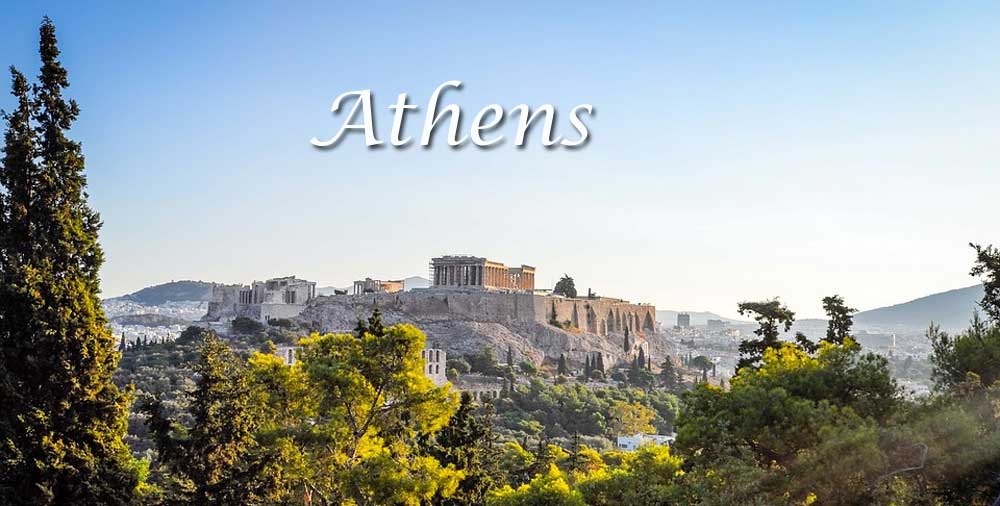
The Acropolis museum of Athens
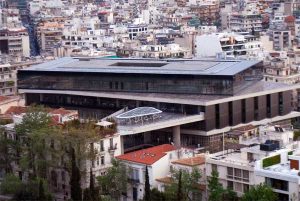 The new Acropolis the museum was founded in 2003 and opened to the public on July 21, 2009. On July 20, 2009, the Museum was grandly inaugurated by the President of the Republic Karolos Papoulias, in the presence of the President of the EU and many foreign leaders.
The then Minister of Culture, Antonis Samaras, in a symbolic move, which was broadcast throughout the world, placed a piece of marble returned from the Vatican Museum, in front of the Parthenon.
This move symbolized the Greek request for the reunification of the marbles in the new Acropolis Museum. The new Acropolis Museum is a total of 25,000 sq.m. has exhibition spaces with an area of 14,000 sq.m. and is located on Makrygianni Street.
International competition
In 2000, a new international competition was announced, inviting 12 offices to submit their proposals. The proposals of the contestants were judged in September 2001 by an international Evaluation Committee and the first prize was awarded to the architectural office of the Franco-Swiss Bernard Tsoumi and to the Greek office of Michalis Fotiadis of Architektoniki Synergasia EPE. The second prize was given to the architects Daniel Libeskind, and Potiropoulos Associates and the third to the Study Office A.N. Topaz.
Location
The museum is located on the southern slope of the Acropolis, on the plot of the former Makrygiannis camp, at a direct distance of 280 meters from the Parthenon.
The main entrance of the building is located on Dionysiou Areopagitou Street while it is surrounded by Makrygianni, Hatzichristou and Mitsaion Streets.
It is served from the “Acropolis” station of Metro line 2. There are secondary entrances from Makrygianni and Hatzichristou streets.
Architecture
The museum is built around a concrete core with the exact dimensions of the Parthenon frieze. Inside the core are placed the support areas while around it, and in the atrium that is created, the exhibition areas of the museum are developed.
The building rests on elevated pillars founded among the antiquities for the best protection of the archaeological site. In several places, inside and outside the building, the floors are transparent, allowing the underlying antiquities to be seen. The museum also provides a 200-seat auditorium, a virtual reality room, an official space and a periodical exhibition room.
Exhibits
 The museum’s collections are displayed on four levels while a fifth houses the auxiliary spaces such as the restaurant, the shop and the official hall.The excavation level is located below the museum building and became accessible at the end of 2011.
On the first level of the museum, the findings of the slopes of the Acropolis are presented, while the long rectangular hall, the sloping floor and the staircase at the end refer to climbing the rock.
On the south side of the hall are widely displayed items from the houses and tombs of the inhabitants of the slopes of the Acropolis, sculptures from the House of Proclus, votive offerings from the small sanctuaries of the House of Pigis, Urania Aphrodite and Eros, Panos, Aglauros and of Apollo.
On the north side of the hall are exposed ceramic vases, votive paintings and other offerings from the sanctuary of Nephi, as well as votive offerings from the Sanctuary of Asclepius and the sanctuary of Dionysus.
The hall of archaic sculptures
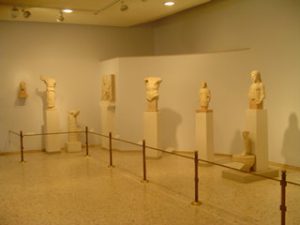
To the northeast, immediately to the left of the scale are the objects from the Mycenaean period, when the Acropolis was still a place of residence and worship at the seat of the local ruler.
The transformation of the Acropolis into a sacred space is marked by the bronze cape of the first temple of Athena Polias.
Sections of the Exhibits
The exhibition of archaic works is made up of seven sections based on thematic and chronological criteria. The sections are:
Architectural sculptures and parts of archaic buildings. The pediment sculptures of the Ekatompedos and the Ancient Temple are presented, as well as the smaller pediments from the first sanctuaries of the Acropolis.
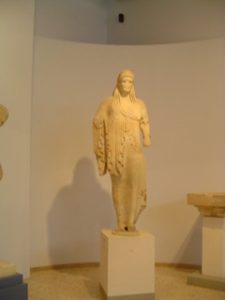
Sculptures of the middle archaic period from Attica with the Peplophorus as the central exhibit.
The Vows of the Knights with Hippo Ramblin as the central exhibit. Monumental Attic works focusing on the Daughter of Antinor.
Daughters and Other Works of the Late Archaic and Early Classical Periods. Important among them are the Victory of Callimachus, the Adolescent of Critius, the Daughter of Euthydicus, the Blond Adolescent and the relief of Thinking Athena.
In the northwestern part of the hall are the objects that follow the construction of the Parthenon and which the visitor sees after the Parthenon hall.
In the Propylaia section, architectural members from the Propylaia and related inscriptions are presented
In the Athena Victory section, the sculptures of the chest and frieze of the temple are presented.
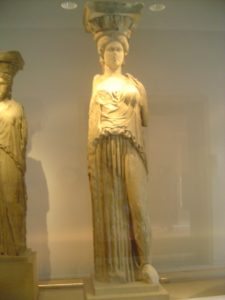
The Erechtheion section presents the friezes, Caryatids and building inscriptions of the building.
In the section of post-Parthenon and later works, sets of works from the classical era to late antiquity and the first Christian times are exhibited.
On the top level of the museum is the Parthenon hall, where all the surviving sculptures of the monument are exhibited in Athens. The transparent glass panes allow direct visual contact with the architectural monument from which they come while simulating the original lighting conditions of the sculptures.
From this room, a panoramic view of a large part of Athens is possible. The visitor first ascends to the core of the hall where observational material, inscriptions and videos about the Parthenon, the construction and the history of the monument are presented.
The floor of this room is transparent and allows viewing and illumination of the archaeological excavation of the ground floor.
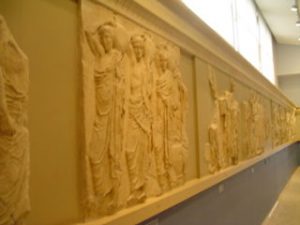 The frieze of the Parthenon rises to a height of 1.50m. integrated into the central core of the building. The frieze depicts the procession of the Panathenaians to the Acropolis and the offering of the veil to the goddess’s altar.
The metopes of the temple were suspended at a height of 2.65m. between the stainless steel columns that support the ceiling of the hall. The metopes depict the mythical battles of gods and men: Centauromachia, Gigantomachia, Amazonomachia and the Trojan War.
The pediments of the temple were placed on low cement bases so that the previously invisible parts of the sculptures were also visible.
The eastern shows the birth of Athena from the head of Zeus, in the presence of the other gods and heroes.
The western pediment shows the dispute between Poseidon and Athena over Attica. The original sculptures are combined with casts of the sculptures found in museums abroad.